
Was Nelson gay?
David Vance SubstackRead More
We all know the story, or at least we think that we do.
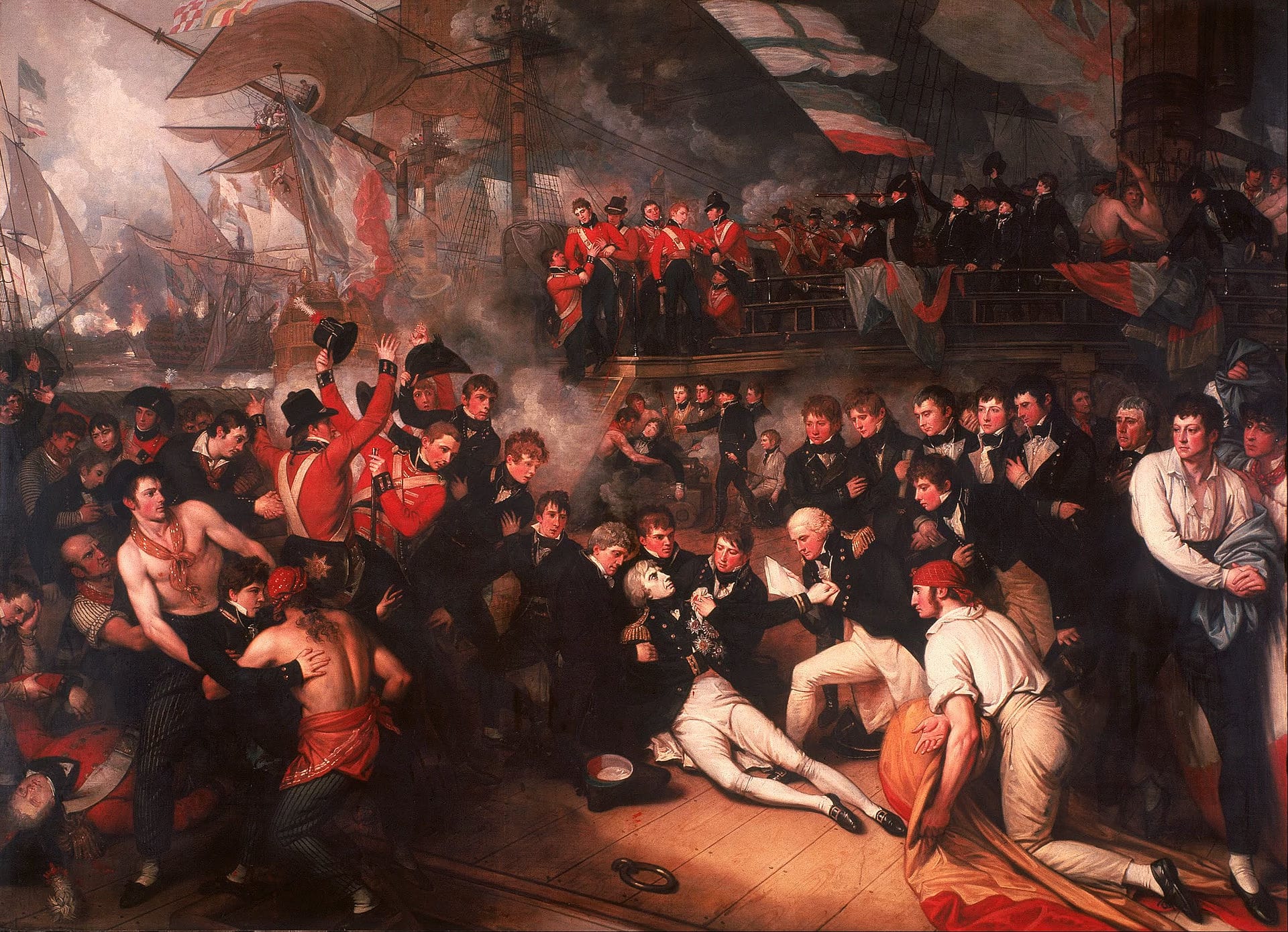
Lord Nelson, one of the greatest naval commanders in history, lay dying on the deck of HMS Victory. A musket ball wound sustained during the Battle of Trafalgar proved lethal. He was shot by a French sniper and carried below, where he died several hours later after learning that the British had won the battle. His last words, according to witnesses, were “Kiss me, Hardy”
According to this narrative, Hardy then kissed Nelson on his hands and forehead. That account has prompted curators at the Walker Art Gallery to put Nelson in the ‘Queer relationships’ collection.
Actually, there is even an alternative to the ‘Kiss Me, Hardy” words. Another interpretation is that Nelson actually said is “Kismet, Hardy,” using the Turkish word for “fate” or “destiny”!
Now this is despite the fact that he had a passionate relationship with his mistress Emma Hamilton and had been married for 18 years to his wife Frances Nisbet when he died! So the evidence suggests that he was NOT gay and the only real source for ths gays claim are his dying words. But what if they are false?
This brings us to the Sievers letter. In December 2024, this letter from a master-at-arms, George Sievers, was put up for auction. He was on the HMS Belleisle, and it describes the Battle of Trafalgar and Nelson’s death. Sievers’ account, written within six days of the battle, claims Nelson said,
“Thanks be to God, but I have lived this day and now I die content”.
This contradicts the widely accepted story of Nelson’s last words being “Kiss me, Hardy” It is also more in synch with all that we understand about Nelson up until this end point of his life.
Now it is also a fact that Sievers was not actually present at Nelson’s death but was on an adjacent ship.
Then there is the evidence of Robert Hilton, a 21-year-old surgeon’s mate on HMS Swiftsure, a 74-gun ship that played its part in the destruction of the French and Spanish fleets and of Napoleon’s dream of invading England. It was 13 days later, after Swiftsure had made it through gales to Gibraltar for repairs that Hilton took up his pen and wrote a nine-page letter home on November 3, 1805.
In it he says Nelson’s last words, relayed to his ship’s company from Nelson’s flag captain, Captain Hardy, were:
‘I have then lived long enough.’
I suppose we will never be certain of his final words but we know he was a truly remarkable man.