
BACK TO THE 70’s WITH ANDY BURNHAM!
The David Vance BriefingRead More
To understand the 1970’s politically, it probably helps to have lived through them!
I did and believe me when I say to you that I would not want to go back there. All of which makes me shake my head in disbelief as British PM Andy Burnham seems to see them as some sort of paradise lost. They were hell.
The 1970’s was a decade of two halves. From 1970 (the year that Burnham was born) to 1974, we endured a spineless Conservative Government led by Ted Heath. You may remember that Heath was a devoted Europhile (amongst other things) and it was under his leadership that the UK joined the Common Market, the precursor to the EU.
But it was the 1974-1979 period that saw Labour grab control of Britain and drive it off the cliff. Harold Wilson led Labour from 1974 to 1976. After his resignation, James Callaghan took over as Labour Leader and the UK acquired the reputation as “the sick man of Europe”! Widespread public sector strikes during the winter of 1978–1979 severely damaged Labour and manifested itself in events such as the Gravediggers Strike. This involved around 80 municipal gravediggers and crematorium workers in Liverpool and Greater Manchester. The dead could not get laid to rest.
Of course this all ended in May 1979 when Margaret Thatcher and her Conservatives won power and that brought the ‘70’s to a shuddering halt.
It seems that Andy Burnham regrets this and has talked about the 1980’s being “the wasted decade” But how was it wasted? Mrs Thatcher restored sanity, fiscal discipline and presided over the restoration of a dynamic UK. Under her leadership we saw the sale of state-owned utilities and companies—including British Telecom, British Gas, and British Airways—widening public share ownership. I remember it well, my Dad worked for British Telecom. She introduced the Right to Buy Scheme allowing millions of council-home tenants to buy their own properties. 1986 saw the “Big Bang” which deregulated UK financial markets, cementing London as a premier global financial centre. Also significantly she reduced union powers through successive laws, notably subduing the National Union of Mineworkers after the 1984–85 strike. All of this was transformative and Britain regained its global reputation. I suspect that Andy Burnham looks aghast at all of these achievements but it was nonetheless undeniably a decade of economic and social revival.
So what is it about that which Andy Burnham finds so lamentable?
I think there are 3 core irreconcilable differences that explain this;
-
Labour believes in the State as the controller and driver of economic growth. This is a core delusion which Burnham reiterated the other day. It is an article of belief for the Left and one that is incompatible with reality. Thatcher empowered the private sector in the 1980’s, but Labour fought it all the way.
-
Labour and the Trade Unions are inextricably linked and whilst there are always tensions between them, the truth of the matter is that Labour tends to advance the interests of the Trade Unions. The fact that 48% of public sector workers belong to a union compares to 12.1% in the private sector tells you plenty.
-
Labour is profoundly pro EU. 95% of Labour MPs campaigned for the UK to REMAIN in the EU and now it is back in Government the links back into the jaws of the Brussels mafia are reopened.
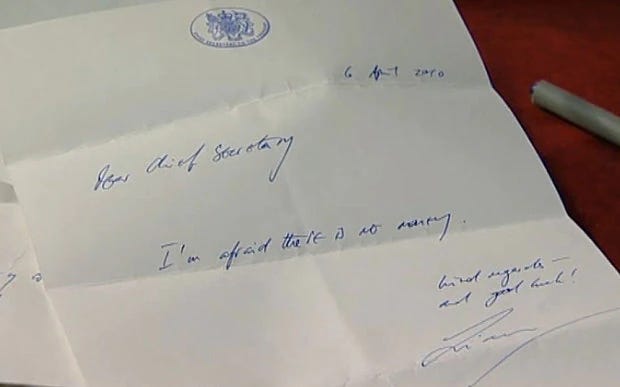
1976 was a memorable year. The summer was good, the music was great, and the UK almost went bankrupt! You see this was the year of the IMF bail out. The £ pound fell to a record low due to high inflation, a weak economy, and massive government debt. Back then, Chancellor Denis Healey turned back from a trip abroad to ask the IMF for help. The UK arranged a $3.9 billion rescue loan. The IMF forced the government to cut public spending and raise interest rates in return. 2026 sees a new Chancellor Healey, John Healey. I wonder if history is about to repeat itself?
The 1970’s saw Britain sink into a debt driven stupor. Labour was at the heart of all of this. Yet Burnham seems almost nostalgic for this time as he recalls it.
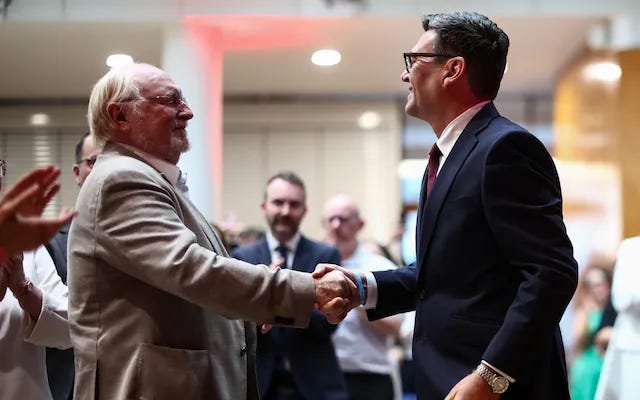
I have posted an image of Labour’s Leader in the 1980’s Neil Kinnock greeting Andy Burnham at the top of this article. That’s because I see Burnham as the spiritual successor to Kinnock but with a Northern accent. It will end in financial disaster because it always does.
Please take a moment to support my work
I publish regular political analysis, overlooked history, book reviews and original commentary that you won’t find in the mainstream media.
Free subscribers receive every article I publish.
Paid subscribers receive everything above, plus The Saturday Briefing — my exclusive weekly analysis launching this September. Each edition will pull together the week’s most important political developments, highlight stories the mainstream media has ignored, and explain what they really mean.
If you value independent journalism and want to help support my work, I’d be delighted to have you on board.