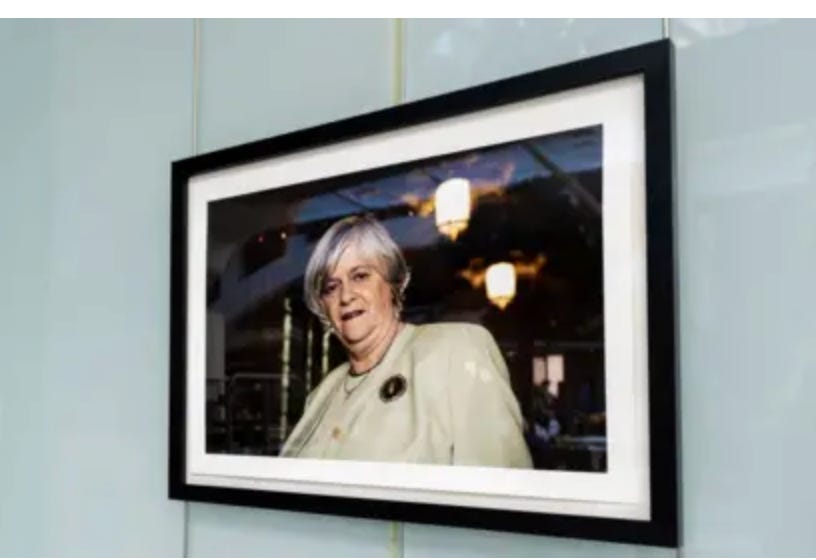
Ann Widdecombe Returns to Westminster
The David Vance BriefingRead More
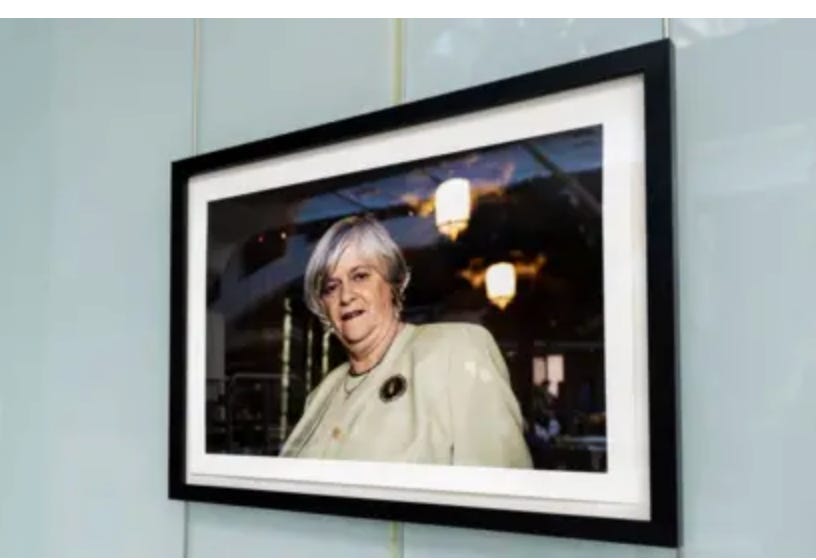
There really is an aching poignancy to this. When MPs return to Westminster after summer recess, Ann Widdecombe will already be waiting for them.
No, I don’t mean in the Commons chamber, obviously.
Instead, a portrait of Ann has been placed in Portcullis House, where hundreds of MPs have their offices.
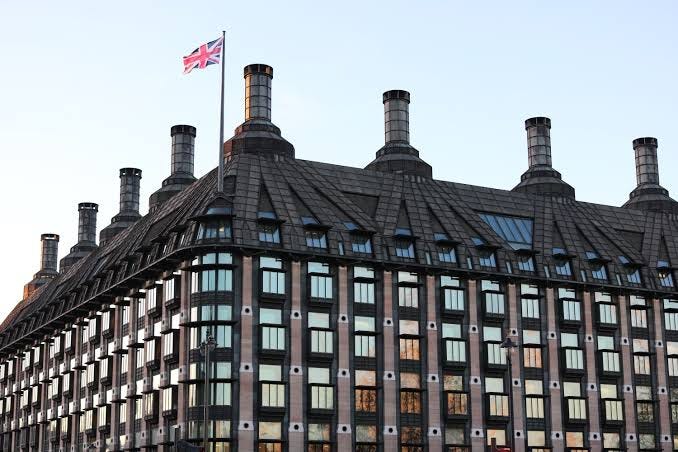
I have been there a few times and it is very busy spot indeed and Ann’s image now observes all that is going on. The photo was taken by Nick Ray back in 2010, the year Ann left the House of Commons after 23 years as an MP. The portrait was installed this past week and it will be there when this Parliament resumes.
I think that is so touching. And also incredibly sad.
We all know that Ann died last month in circumstances that shocked the country. A man has been charged with her murder and is due to stand trial next year, so obviously I am not going to comment on the circumstances surrounding her death.
So instead I want to talk about Ann herself. You see that photograph hanging in Portcullis House represents something considerably bigger than another Westminster memorial. It represents a type of politician that Britain has lost.
A conviction politician
Let’s recap the details. Ann first entered Parliament in 1987 as Conservative MP for Maidstone and remained there until 2010. During those years she served as Employment Minister and Prisons Minister, later becoming Shadow Health Secretary and Shadow Home Secretary. She was appointed to the Privy Council in 1997. After leaving Westminster, she returned to elected politics as a Brexit Party MEP and latterly became Reform UK’s Immigration and Justice spokeswoman.
But those basic facts don’t really explain Ann. What made her stand out was something much simpler.
You knew exactly what she believed.
I know that seems old fashioned now!
Ann had clear views on Christianity, abortion, immigration, Europe, crime, the family and the nature of Britain itself. You could agree with her or disagree with her — and plenty did — but nobody seriously imagined she was consulting a focus group before opening her mouth. In fact, I believed she thrived on people disagreeing with her as it allowed her to hone her arguments. Another reason I respected Ann was that she was prepared to be unpopular. That quality is almost revolutionary in modern politics.
These days, they all want to be loved. This is the age of politicians who behave as robots assembled in laboratories by communications consultants. Every phrase is tested. Every answer is qualified. Every potentially controversial thought is wrapped in enough verbal cotton wool to survive a collision with the BBC.
Ann was the opposite of this. She said what she thought and dealt with the consequences afterwards. That is why people remember her. There was an inner authenticity that shone out of her.
Respect across the divide
One of the things that struck me since Ann’s death is the respect afforded to her by people who profoundly disagreed with her politics.
Commons Speaker Lindsay Hoyle described her as “a formidable and principled politician who spoke her mind and remained true to beliefs informed by her Christian faith.” He also recalled their personal friendship despite their political differences.
Politics involves disagreement. Fierce disagreement, sometimes. It always has. But it’s a modern notion that disagreement itself constitutes hatred . That would have been completely alien to Ann. She could deliver and receive political blows and then carry on with life. Maybe Parliament could use a little more of that?
Helen Grant is the lady who succeeded Ann as MP for Maidstone and The Weald, and she has described the new portrait as just the beginning of a lasting tribute. Discussions are now taking place about a permanent parliamentary commemoration.
I do hope that happens. You see there are already memorial shields in the Commons itself commemorating Jo Cox and Sir David Amess, both murdered while serving as MPs. Following Ann’s death, even Starmer suggested that Parliament should consider a similar tribute to her. That would be fitting.
Something Parliament needs to remember
But I hope MPs will do more than glance at Ann’s photograph as they hurry through Portcullis House. I hope some of them actually stop, take a moment and think about what she represented.
Because Ann belonged to a political tradition in which politicians were expected to possess beliefs before entering Parliament.They weren’t merely professional political operatives. They held these principles dear and occasionally those principles cost them something. In Ann’s case, it cost her life.
Her Christian faith shaped her worldview and sometimes placed her dramatically outside fashionable opinion. I love that aspect to her and relate to it myself
Her Euroscepticism similarly preceded the great Brexit realignment. When Britain finally voted to leave the European Union, she enthusiastically returned to frontline politics and became a Brexit Party MEP.
Ann was like the Duracell bunny in that she kept on going. In fact it was a stubbornness that was part of her charm.
Even her totally unexpected transformation into a TV personality revealed something about her. The supposedly austere politician went onto Strictly Come Dancing, cheerfully made herself look ridiculous and discovered that millions of people rather liked her for it. That’s because she possessed something increasingly rare in public life: A personality. Ann could be serious without being permanently solemn.
Welcome back, Ann
So when 650 MPs walk back into Westminster next week, Ann Widdecombe will be looking down at them once again. There is something beautifully appropriate about that. Some of those MPs will have agreed with almost nothing she believed. Others may have admired her. But virtually all will recognise her. And perhaps that is the final lesson of all.
Politics isn’t ultimately about cultivating universal approval. It is about standing for something sufficiently clearly that people understand what you represent.
Ann did that for almost four decades. That was a long time, it was a lifetime
In an increasingly bland political culture her courage, humour and sheer bloody-minded independence seem more valuable than ever.
Her chair in Parliament has long since been occupied by others and her voice has fallen silent. But now her face is back on the walls of Westminster.
STOP!
Please take a moment to support my work
I publish regular political analysis, overlooked history, book reviews and original commentary that you won’t find in the mainstream media.
Free subscribers receive every article I publish.
Paid subscribers receive everything above, plus The Saturday Briefing — my exclusive weekly analysis launching this September. Each edition will pull together the week’s most important political developments, highlight stories the mainstream media has ignored, and explain what they really mean.
If you value independent journalism and want to help support my work, I’d be delighted to have you on board