
THE TRUTH ABOUT WHAT IS HAPPENING AT CEUTA AND A WARNING FROM HISTORY
The David Vance BriefingRead More
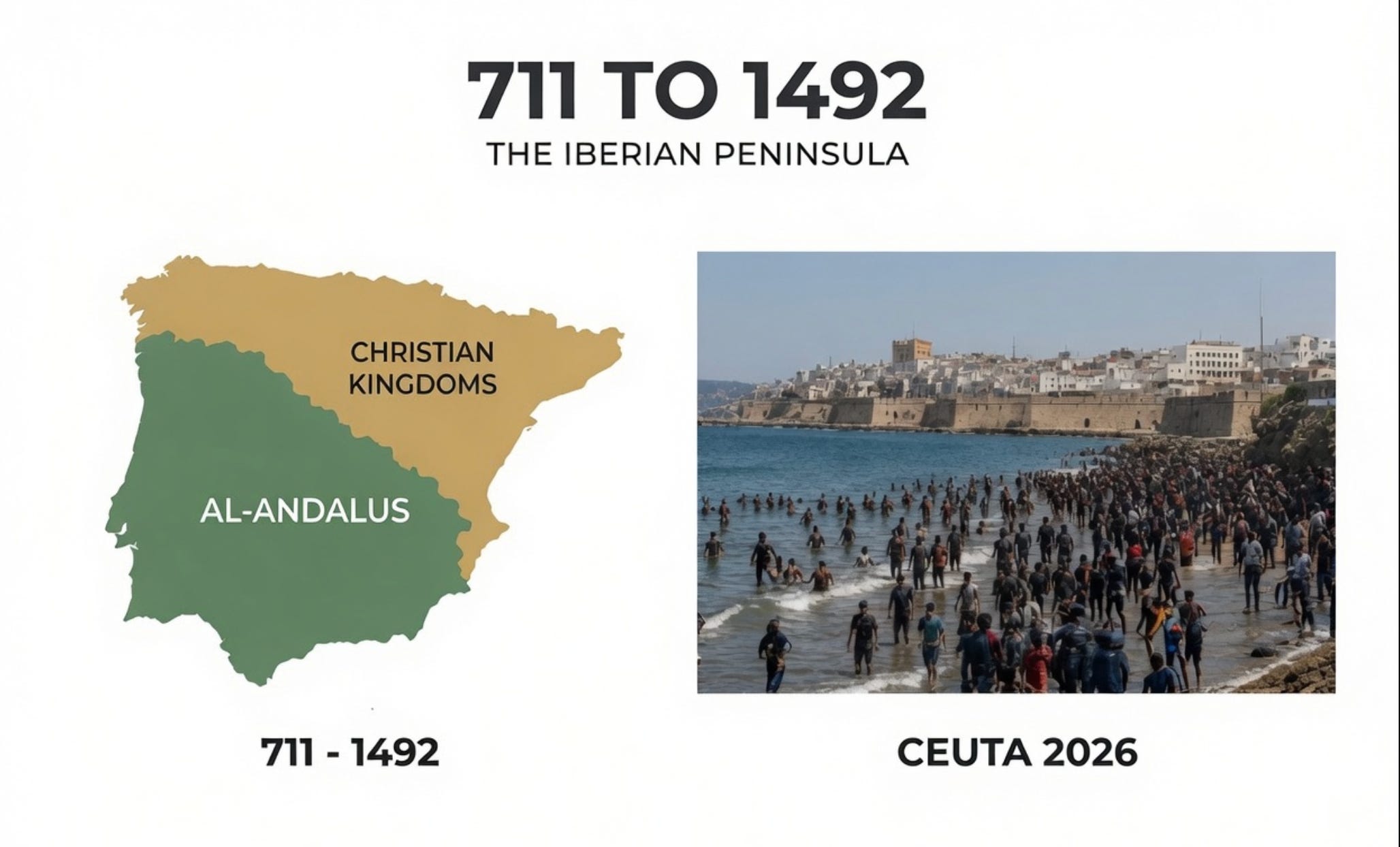
It isn’t just the weather that is hot in Spain; so too is the political climate in the aftermath of the invasion of the Spanish-controlled enclave of Ceuta by Moroccan hordes.
Now, if we had believed the Spanish Socialist Prime Minister, Pedro Sánchez, and much of the Spanish media in the early stages, it was only a few thousand Moroccan migrants who had illegally entered Ceuta, and prompt action was taken to remove them. When it became obvious that the number was more than 72,000, the story became an international scandal. Even the EU had to pretend to be concerned, and countries such as Italy unilaterally closed their borders to Spain, despite both being part of the Schengen Area.
Now the media is telling us that it has all been sorted out. Sánchez even blamed his European partners for being “unhelpful”, thereby asserting his own victimhood. We are informed that almost all of the migrants have gone back home.
But that’s a lie.
The Daily Telegraph reports that many Moroccan children are still in Ceuta. Under Spanish law, any unaccompanied minors are entitled to immediate protection and child welfare support. You can understand the humanitarian thinking behind that, but in practice Ceuta’s reception system was already stretched beyond breaking point, and the sudden influx overwhelmed shelters, staff and basic services.
Reports from the crisis described facilities for minors operating at several thousand per cent of capacity, with the city scrambling to improvise additional space and care.
The scale of the problem is still unclear, but official estimates suggested that roughly 860 minors were still in Ceuta days after the mass crossing, while other local figures put the number closer to 1,000.
Furthermore, reports from independent journalists on the ground claim the wider number of migrants remaining in the enclave could be between 3,000 and 5,000, with children making up a significant and particularly vulnerable proportion of those still awaiting transfer, reunification or placement.
Spain has since moved to increase funding and expand reception capacity, but the crisis exposed a deeper structural weakness. Child protection rules exist, yet they depend on local systems that can be instantly overwhelmed when migration surges occur on this scale. The truth is they were never designed to cope with illegal migration on anything like this scale.
The best way to protect these children is to stop the Moroccan hordes from entering in the first place, and that is something the Spanish Prime Minister appears to have an ideological aversion to doing. It seems likely that there will be further mass incursions into Spain.
Have a look at this scene, filmed on a beach in Andalucía.
It looks like something from a disaster movie. Yet this is modern Spain.
It is also one of the reasons Sánchez is pressing ahead with the regularisation of around one million North African migrants. That policy will fundamentally change Spain, and Ceuta is simply the latest example of what many see as the consequences of his brand of socialist government.
I have also read reports that, according to at least two Spanish media outlets, the authorities have identified several suspected jihadists among the Moroccan hordes. Officers from the National Police’s General Information Commissariat and the Civil Guard’s Intelligence Headquarters reportedly studied surveillance footage and identified at least a dozen individuals who had previously been arrested, convicted and later deported to Morocco for offences linked to jihadist terrorism.
Now, it would be wrong to suggest that Spain is taking no action to deal with these illegal migrants. Evidence suggests that some are simply being transferred to… mainland Spain. Andalucía, to be precise.
In 2015, Angela Merkel opened Europe’s borders to mass immigration, and that decision has caused profound and lasting damage to many European societies. In 2026, Pedro Sánchez appears determined to continue down the same path. Spain is rapidly becoming Europe’s weakest link, and unless that changes, what happened in Ceuta will not be remembered as an exception. It will be remembered as a warning of the fate that lies in store.
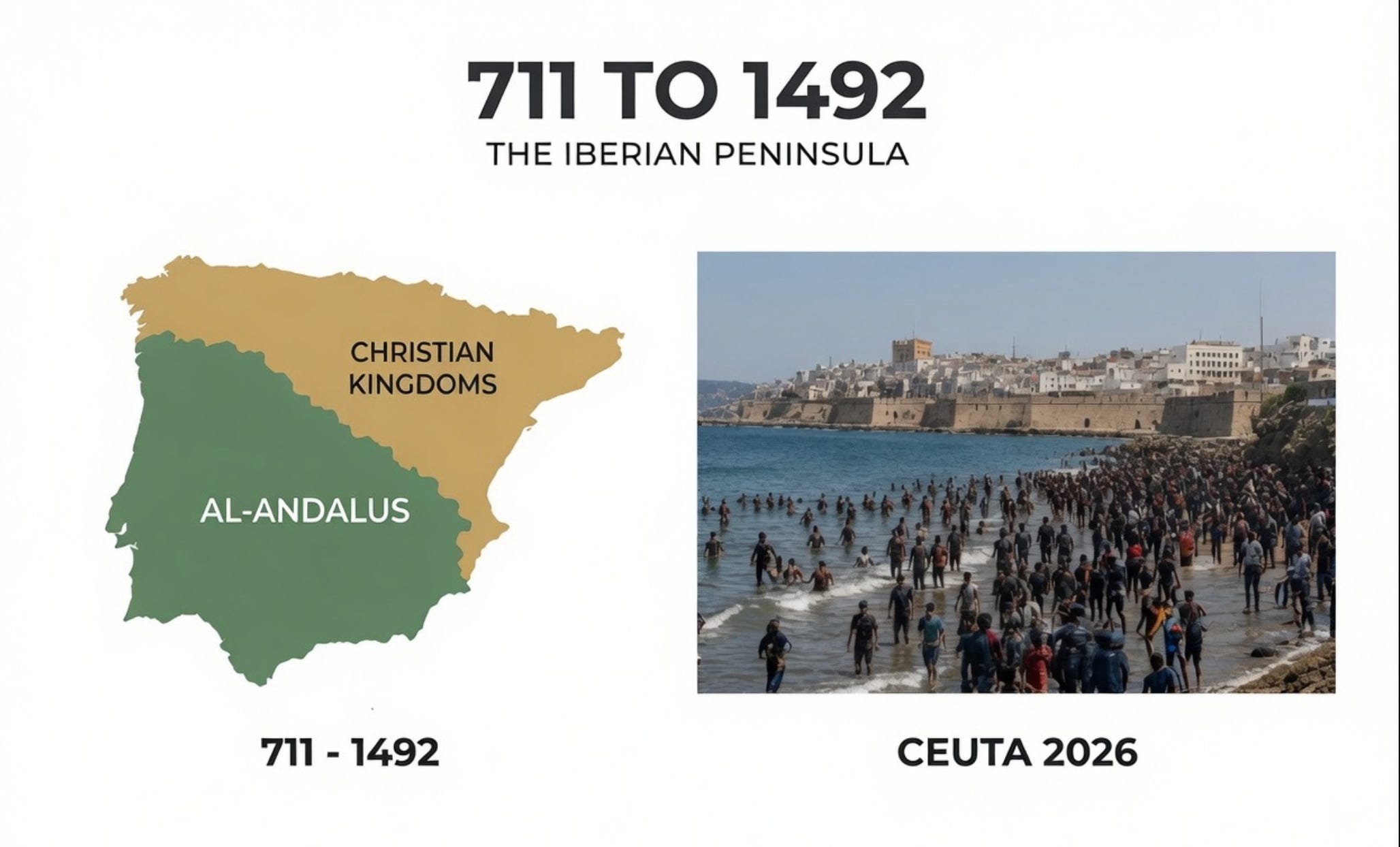
Here’s a historical fact to think about. The Muslim conquest of most of the Iberian Peninsula began in 711 AD and was completed remarkably quickly. It took until 1492 for the Christian Reconquista to finally repel Muslim power. In contemporary Islam, “the tragedy of Andalucia” is still mourned and it looks forward to recapturing that geography.
In that respect, Ceuta is simply a stepping stone and the way back in is paved with Socialist fantasy and Judicial insanity.
If you’ve enjoyed reading this, I’d love you to join the community.
I publish regular political analysis, overlooked history and the occasional book review that challenges the mainstream narrative.
Free subscribers receive every article. Paid members also receive The Saturday Briefing, my exclusive weekly analysis launching this September.
If that sounds like your sort of thing, come aboard.