The Memorandum of the Meaningless!
The David Vance BriefingRead More
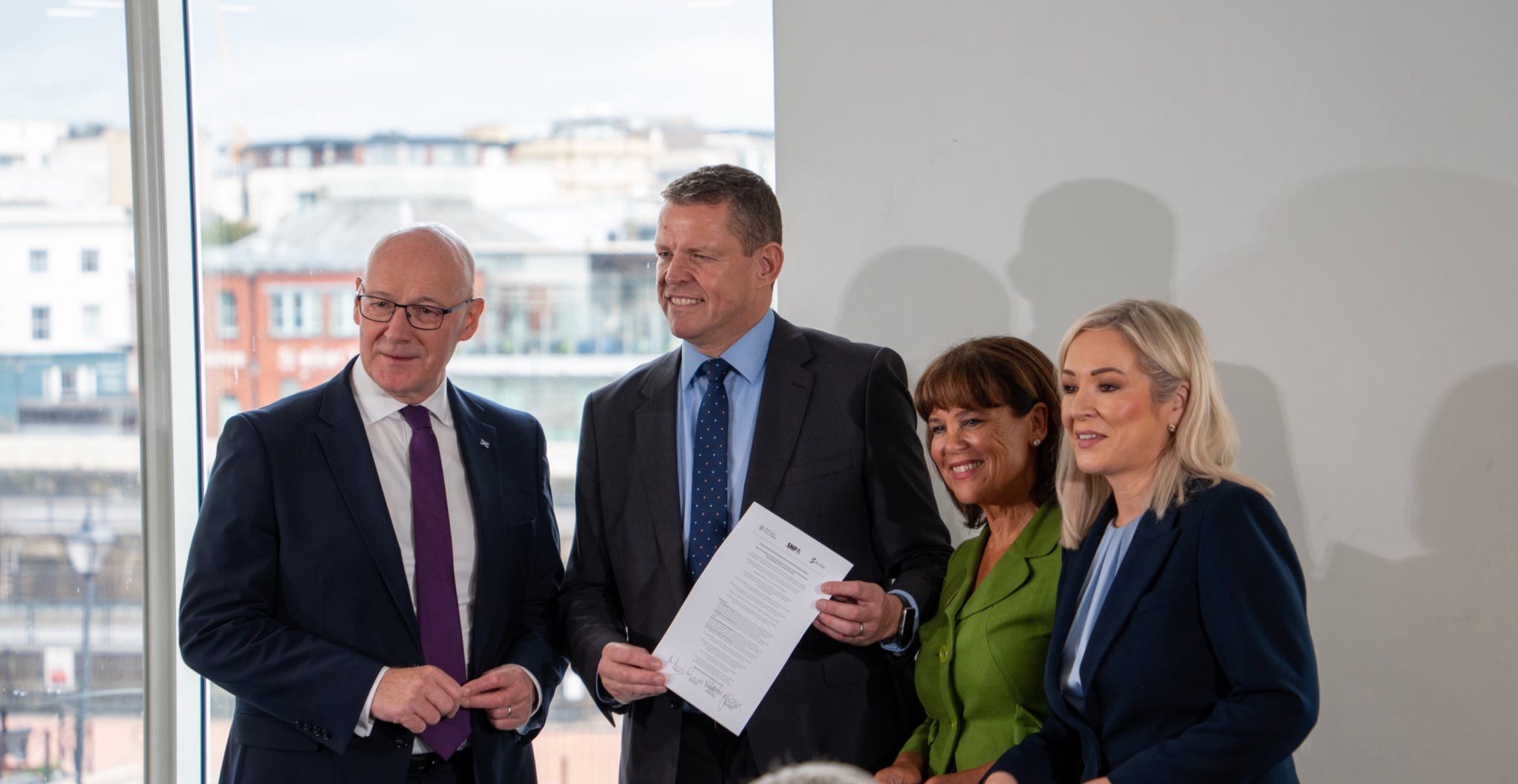
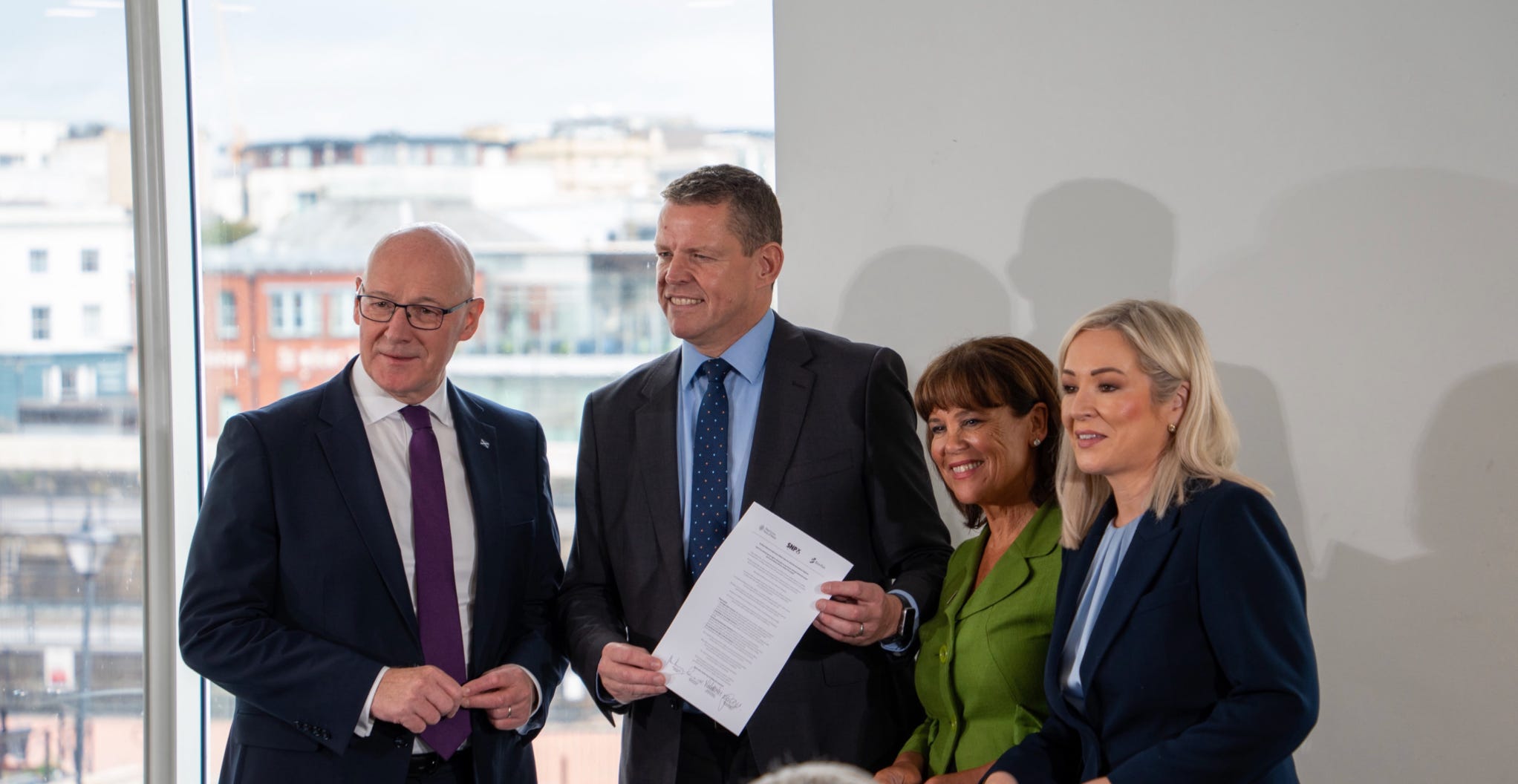
In one way, I almost feel sorry for the chieftains of Celtic Separatism as they gathered in Cardiff to virtue signal their absolute political impotence! The SNP, Plaid Cymru and Sinn Fein decided to conduct a love-in and then pretend that it had real significance. In reality, it had NO significance beyond creating a little bit of political theatre for these sore separatist losers. They needed something to show for it and so this memorandum (below) was published and the mainstream media got ever so excited about it even as the rest of us cringed at their indulgence.
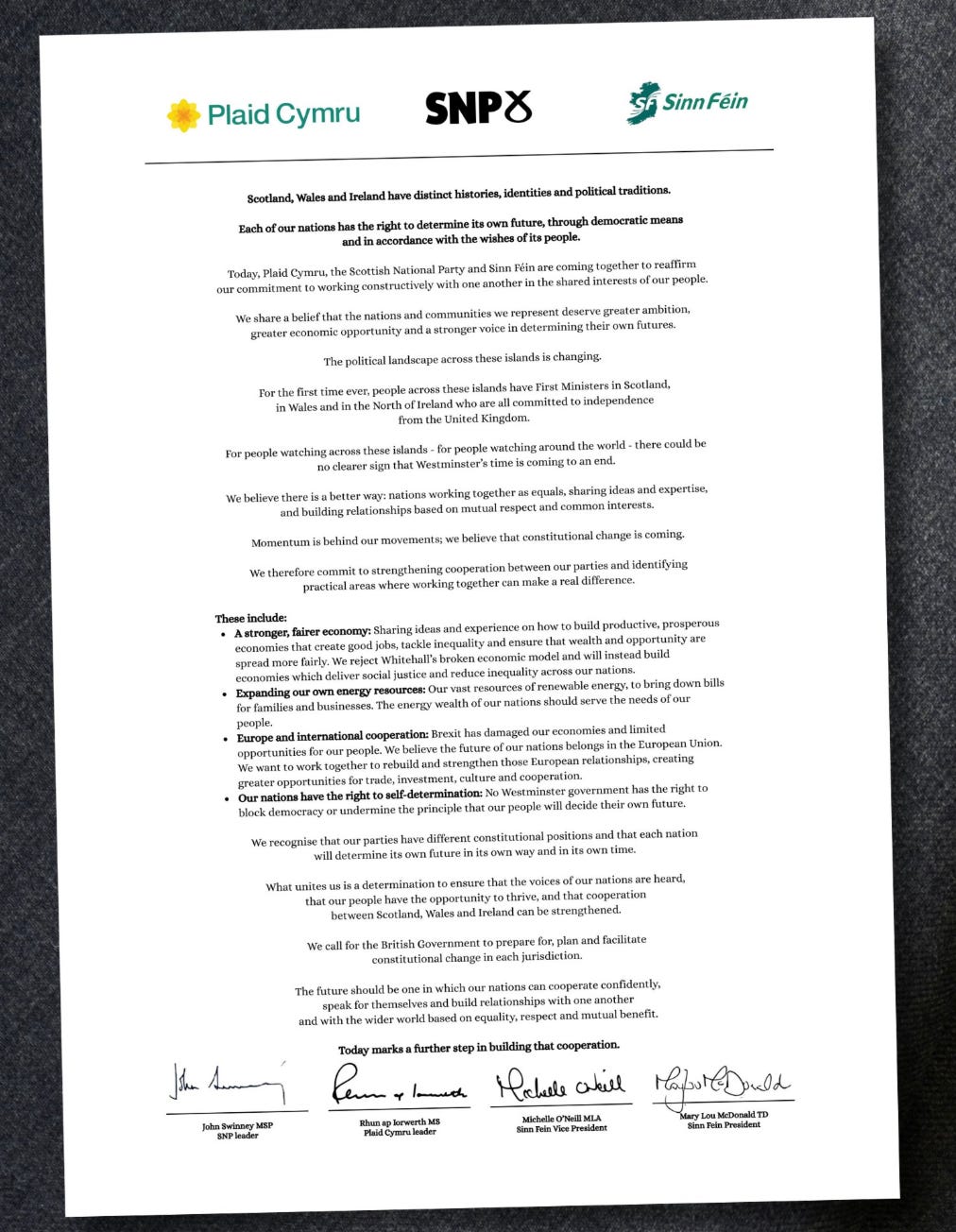
Let’s start from the very top by making it abundantly clear that this memorandum is simply political theatre dressed up as destiny. This is three separate political parties with overlapping grievances and incompatible objectives producing a document that treats electoral luck as historical inevitability. Their absurd claim that “Westminster’s time is coming to an end” is not analysis.
It is merely separatist incantation.
Let’s take a few minutes together to understand some of the fundamental problems flowing from this so you can see why it’s all hype.
For starters, the three projects being pursued are not the same. The SNP wants an independent Scottish state. Plaid Cymru wants an independent Welsh state. Sinn Féin wants Irish unification — Northern Ireland leaving the UK to join the Republic of Ireland. Yet if you read the text it repeatedly speaks of “Scotland, Wales and Ireland” as if they were parallel cases. They are not and wishful thinking won’t make it so!
The Irish Republic is already a sovereign state. What Sinn Féin seeks is a border poll under the terms of the Good Friday Agreement, a mechanism that requires the NI Secretary of State to judge that a majority is likely to vote for change. That is a TOTALLY different legal and political process from Holyrood or the Senedd demanding a secession referendum. Lumping them together as a single “independence” wave is rhetorical convenience, not constitutional reality.
And then there is the small matter of actual public opinion not matching the soaring Separatist rhetoric. In Scotland, the 2014 Independence referendum showed a majority did NOT want what the SNP wished to see. Whilst the May 2026 Holyrood result produced a larger number of pro-independence MSPs the combined SNP–Green vote share fell to around 41 per cent. John Swinney can cite “trends” all day long but he cannot cite a consistent, decisive mandate.
Wales is even further away from the document’s picture. Independence polling has sat in a narrow band for years: typically mid-20s for Yes, a clear majority for No. The most recent polling data I could find puts support for Welsh independence at roughly 26% Yes vs 51% No (with ~23% undecided), or 32% Yes vs 68% No among those who express a voting intention. Even after Plaid’s Senedd victory, support for leaving the UK remains a minority position. A substantial share of Plaid own voters do not back independence, with a figure of 33% seeming close to the mark! Winning an election on competence, language, or anti-Labour sentiment is not the same as winning an argument for a new State. Treating a first-ministership as proof that “the people” have chosen secession is a profound category error but one they are quite happy to make.
Here in Northern Ireland where I live things are different again. Support for Irish unity has risen in some polls, but it has not produced anything like the sustained, clear majority the Belfast Agreement’s threshold implies, and the MAJORITY unionist community’s existence cannot be wished away by a joint press conference in Cardiff. A unity vote here would reopen questions of identity, policing, symbols and security that the 1998 settlement was designed to contain. Presenting Michelle O’Neill’s office as equivalent to Swinney’s or ap Iorwerth’s on “independence from the United Kingdom” flattens a uniquely fraught case. Michelle O’Neill was present to represent Michelle O’Neill/Sinn Fein and it was embarrassing to behold. She brought along her boss from Dublin, Mary Lou McDonald for extra lolz!
Now let’s take a look at the economic and practical claims contained in the Memorandum because they are equally thin gruel. “Reject Whitehall’s broken economic model” might be easy to write down but what on earth does it mean? All three territories run structural fiscal deficits relative to the UK average; independence would convert those transfers into tough choices on tax, spending and borrowing.
Let’s look at what this actually means in indisputable hard facts
Wales has a notional fiscal deficit of around £7,150 per person driven by lower tax revenues relative to the UK average. Scotland recorded a notional net fiscal deficit of £25.3 billion (10.9% of GDP, or about £4,560 per person) almost entirely due to higher public spending per head. Northern Ireland tops the charts with the largest per-person notional deficit of the three nations, around £8,200 in 2024–25, reflecting both higher identifiable public spending and lower revenue-raising capacity.
All the fine talk about Economic Independence is just fantasy. It’s gaslighting us without the gas!
We hear lots of talk about “Scotland’s oil”but the SNP supports “a managed, just transition to net zero”, whatever that means! It’s incoherent! Wales’s own economy is very tightly integrated with that of England. A post-independence dash into the EU — presented here as “obvious common sense “— would require lengthy accession, adoption of all European laws and, for Scotland and Wales, a customs and regulatory border with their largest market, England. Also let’s not forget that Wales voted to Leave the EU!
The Memorandum document simply asserts that “the future of our nations belongs in the European Union” as if the 2016 Referendum and subsequent trade patterns had not happened. There’s always delusionalism at the heart of Separatism!
They talk about energy cooperation but even here the memorandum oversells it! Renewable resources are, of course, real. But so is Intermittency, grid connections, planning, and who pays for backup capacity! No mention of any of those! Sharing “ideas and experience” does not dissolve those constraints, nor does it turn three small, open economies into a self-sufficient bloc!
Finally, the document’s theory of democracy is every bit as selective as you might expect! It insists that no Westminster government may “block democracy.” The UK Supreme Court has already held that Holyrood cannot legislate a referendum on its own. The current UK government has plainly stated that a second Scottish vote is not on offer. Self-determination may be a principle but it’s not a unilateral right for a devolved executive to dictate.
The memo acknowledges that each nation will move “in its own way and in its own time,” which is a polite way of admitting that the three political calendars do not align. That very admission undercuts the wild claim of “gathering, unstoppable momentum”.
So what are we left with? Well, we have Separatist parties that benefit from blaming London for all their ills; we have a vague communiqué; and a prediction that the present Prime Minister Andy Burnham will be the last of the United Kingdom. This is not a programme for Independence, it’s just a vibe!
To be clear; this memorandum is not a blueprint. It’s a wish list. That is why it reads as fantasy: it treats minority or marginal majorities as settled will, then presents incompatible destinations as a single journey, and political theatre as constitutional fact.
I am going to return to the broader issue of Devolution in this week’s Saturday’s Briefing as the more I study it the more we see that it was Blair’s error in 1997 that ended up in this asinine conference in Cardiff!
***If you think more people need to hear this argument, please Restack it!***
Please take a moment to support my work
I publish regular political analysis and commentary on the stories that matter — and some the mainstream media would rather ignore.
Free subscribers receive every regular article I publish.
Paid subscribers also receive The Saturday Briefing — my exclusive weekly analysis, where I take a deeper look at the political stories and developments I think really matter.
If you value independent commentary and want to support my work, I’d be delighted to have you on board!