
Reform vs Restore: Who Will Shape the Future of the British Right?
The David Vance BriefingRead More

Politics has never been about agreeing on everything. If it were, no political party would ever exist. It’s about getting enough people moving in the same direction to change the country.
That is why Rupert Lowe’s recent offer to work with Reform UK is worth taking seriously. Yes, he attached conditions. Yes, there are obvious personal differences between him and Nigel Farage. But at least the conversation has shifted away from just personalities and towards something much bigger. That has to be something that we can welcome!
Can the British Right finally learn to work together?
We’ve all heard the old saying that victory has many fathers while defeat is an orphan. Looking at the history of the British Right, I’d suggest another saying deserves to be added.
The Right has an unfortunate habit of fighting itself just when victory comes into sight.
That danger feels very real today.
Labour’s revival under Andy Burnham is precisely why this debate matters. If the Right spends the next few years arguing with itself, it risks squandering what should be one of the greatest political opportunities in a generation.
The Conservatives remain a shadow of what they once were. Reform UK has indisputably emerged as the dominant force outside the old political establishment.
The next General Election is there to be won—but only by a movement capable of convincing the public it is serious about governing.
And yet, just as that opportunity appears, bang on cue, familiar cracks begin to show.
Restore Britain was launched because many people believed there was room for another stronger movement on the Right. Some wanted something more democratic than the perceived authoritarianism of Farage. Others wanted something more radical. Others simply felt Reform wasn’t enough.
Now I understand those ambitions and have sympathy with them .
However the hard truth is that politics isn’t just about good intentions.
It’s about whether you can persuade millions of voters.
Reform Is the Main Player Whether you admire Nigel Farage or can’t stand him, one fact is impossible to ignore.
Reform UK is now the biggest political force on the British Right.
The local elections on May 7th proved that beyond any serious doubt.
Farage has spent the best part of thirty years building his reputation. I first met Nigel Farage back in 1999. Whatever people think of him today, he’s spent over a quarter of a century building his public profile. That sort of recognition can’t simply be replicated overnight. All of that gives Reform something no rival currently possesses.
Momentum.
Which is why any movement setting out to replace Reform faces an enormous uphill struggle.
Trying to influence Reform’s direction is one thing. but trying to overtake it is quite another.
Catherine Blaiklock’s Experience
That brings me to my recent interview with Catherine Blaiklock. You can watch it here!
Having been involved with Restore Britain she offers an insider’s account of why she eventually decided to walk away. Readers will make up their own minds about her conclusions. But I think it’s fair to say that first-hand experience matter?
Political movements rarely collapse because they run out of ideas. More often they struggle because of organisation, leadership, trust and personalities. I speak from experience on this!!
Restore Britain’s challenges should be a lesson for anyone thinking politics is simply a matter of launching another party. Building a credible political movement is incredibly difficult. The fact that Rupert Lowe has already attracted significant attention underlines that.
The Left Doesn’t Make This Mistake
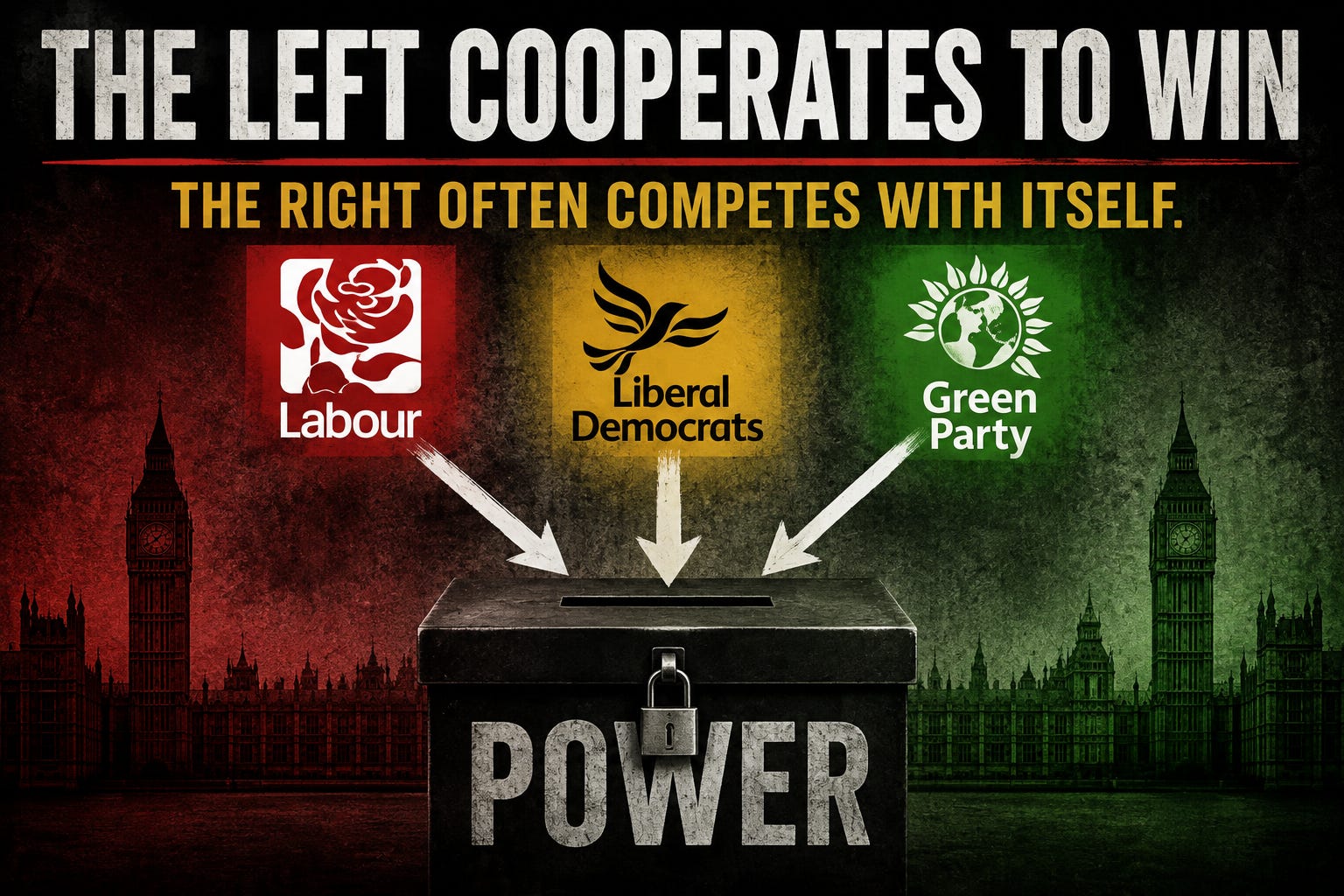
Here’s something I’ve noticed. The Left can disagree violently with itself.
Labour argues with the Greens. The Greens argue with the Liberal Democrats. Trade unions fall out with Labour ministers.
Yet when an election approaches, they often find ways of working together where it suits them. We’ve seen evidence of that in places like Gorton and Denton and Makerfield.
Their activists understand something that many on the Right still seem reluctant to accept. Winning is what matters.
Nobody hands out trophies for coming second with the purest principles.
Too often the Right has behaved as though complete agreement is a condition for cooperation but politics simply doesn’t work like that.
Time Isn’t Standing Still
There is another reason this matters and it is obvious to us all.
Britain is changing. Mass immigration, changing demographics and cultural change are reshaping the country. Many on the political Left welcome those developments, while many on the Right see them very differently. Reform and Restore supporters believe those changes have gone too far and that successive governments have failed to respond. I happen to agree with them.
If you genuinely believe Britain is moving in the wrong direction, then surely the last thing you should want is another split among people broadly trying to achieve the same objective.
Time is not standing still and every election that passes closes one door and opens another.
Rupert Lowe’s Intervention
That is why Rupert Lowe’s comments matter. He’s made it clear that he still has disagreements with Nigel Farage. Nobody is pretending otherwise. But he has also made it clear that cooperation may be possible.
Personally, I think that is a far more interesting conversation than another round of social media point-scoring. Our electoral system is brutally unforgiving.and if you split the vote someone else usually walks away with the prize.
One thing that we can all agree on is that Farage understands elections. Lowe understands business, organisation and many of the frustrations felt by grassroots activists. Catherine Blaiklock has highlighted what can happen when a new political movement struggles to find its feet.
Those aren’t competing stories. and together they point towards the same question.
Can the British Right build something bigger than the sum of its parts?
The Real Test
History won’t remember who won the latest argument on X. It will remember who governed Britain when the opportunity finally arrived. It definitely won’t be decided by press releases or personality clashes either.
It will be decided by whether people who broadly agree on Britain’s direction can put enough trust in one another to work together.
Donald Trump’s victories in 2016 and again in 2024 demonstrated the importance of assembling a broad electoral coalition, even among supporters with differing priorities and viewpoints.
The lesson seems obvious.
Politics isn’t won by finding perfect allies. It’s won by building large enough coalitions to secure power.
That is what the Reform–Restore debate should really be about.
Not Nigel Farage. Not Rupert Lowe.
But whether the British Right can avoid repeating a mistake it has made far too many times before. Because if it can’t, Labour may not have to defeat the Right at the next General Election.
The Right may simply do the job for them.
If this article made you think, you’ll probably enjoy my other work.
I publish original political analysis, overlooked history and book reviews that challenge the mainstream narrative.
Free subscribers receive my regular articles.
Paid members also receive The Saturday Briefing—my exclusive weekly analysis launching this September.
Join thousands of independent-minded readers by subscribing today.