Britain Isn’t Booming. It’s Being Restocked.
The David Vance BriefingRead More
Have you seen the news that the UK population has now reached 69.5 million? At first glance, that sounds like quite a milestone. Almost 70 million people living in Britain. Proof that we are a thriving country, right? And then you might assume that this is because Britain is having more children.
It isn’t.
The really interesting story behind that 69.5 million figure is not the size of the population. It is how we are getting there. That’s what I want to delve into in this Saturday Briefing.
The latest figures from the ONS show that the UK population increased by around 228,000 in the year to the middle of 2025. That sounds like a lot. But when you look at the figures underneath, something remarkable emerges.
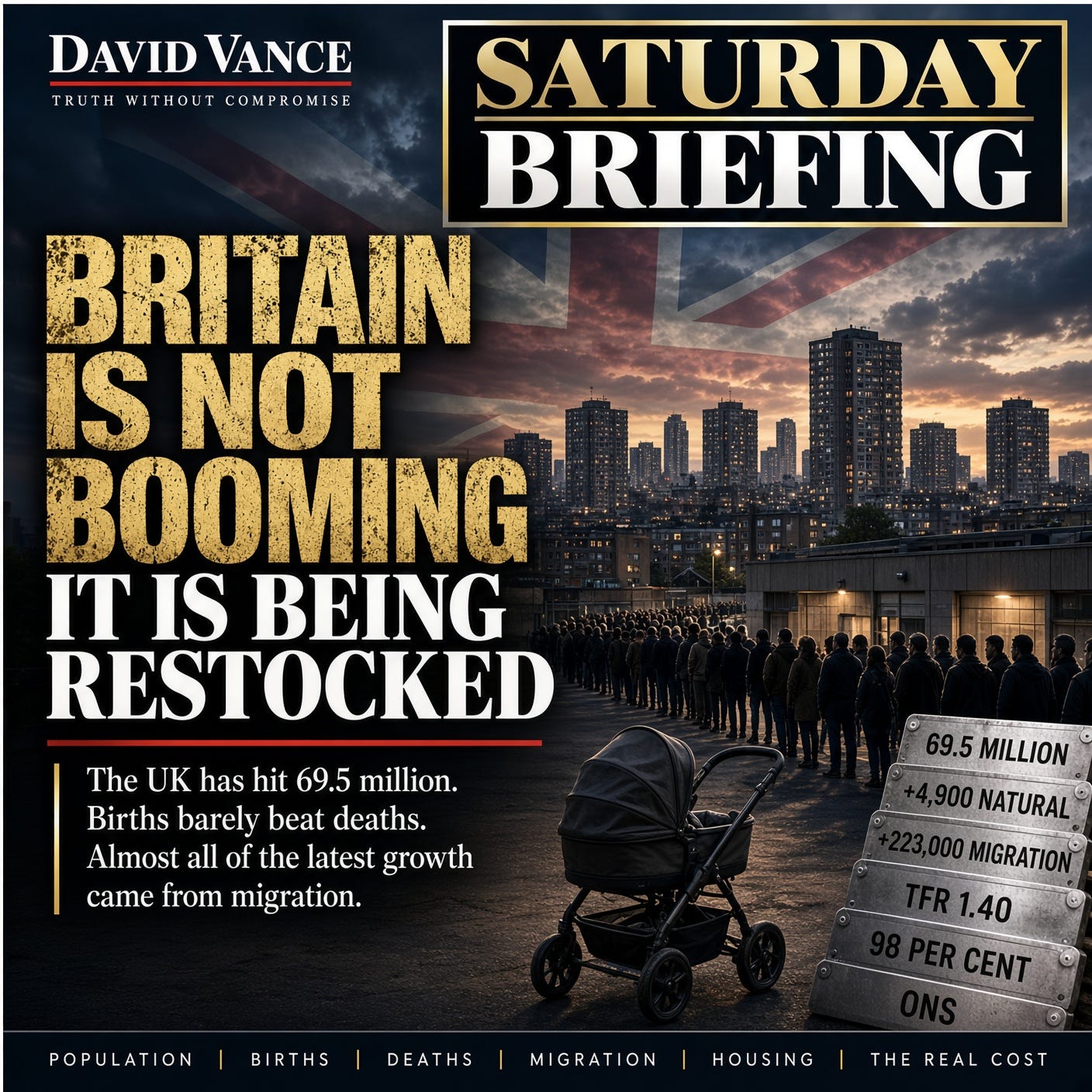
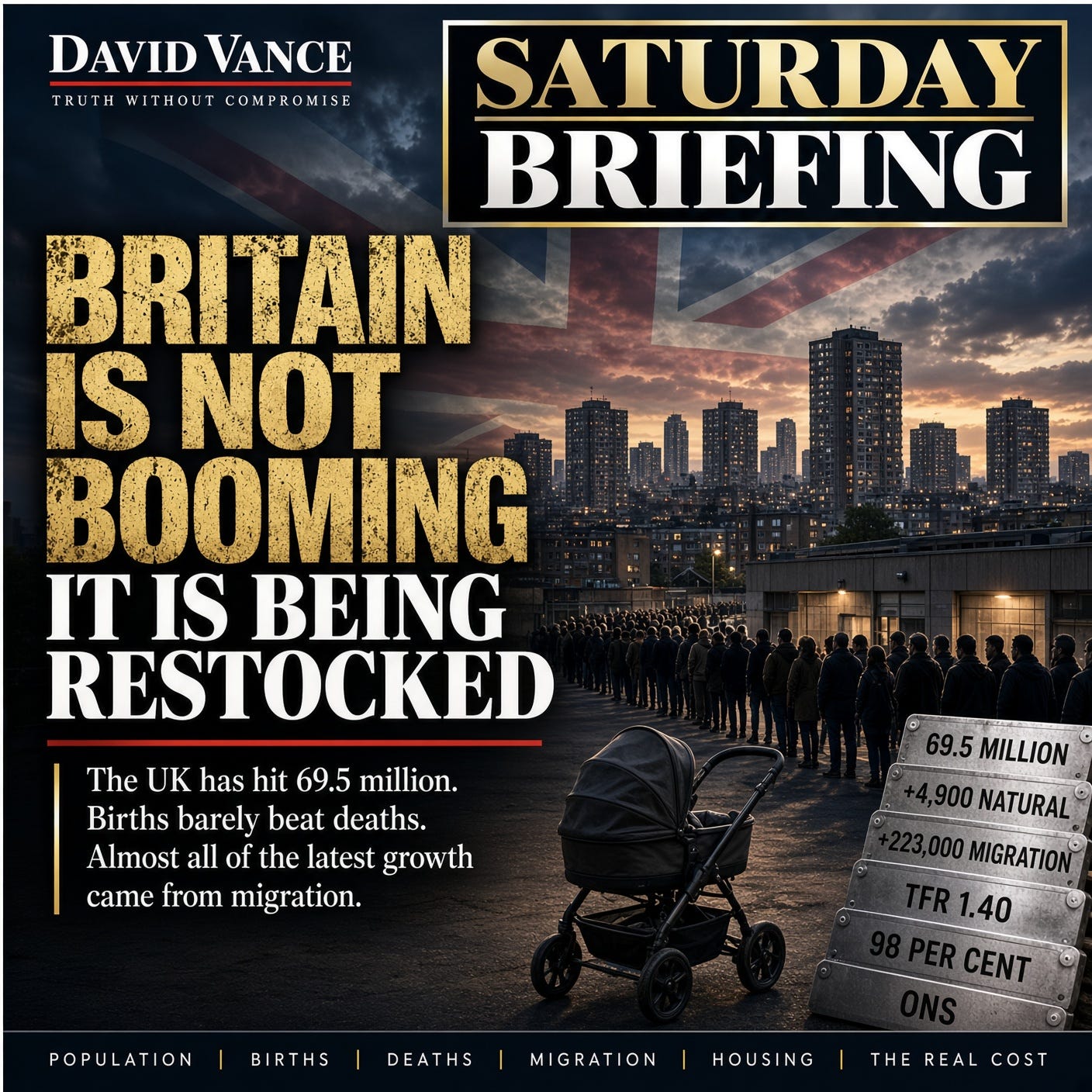
There were around 652,400 births and 647,500 deaths. In other words, the natural increase in the population — births minus deaths — was only about 4,900 people.
Net migration, meanwhile, was around 223,000.
So roughly 98 per cent of the increase in the population in that year came from net migration rather than from the British population reproducing itself.
That is the figure that matters.
Britain is not experiencing a demographic baby boom. Quite the opposite. Our fertility rate has fallen to remarkably low levels. The total fertility rate in the UK was just 1.40 children per woman in 2024, according to the ONS. The ONS currently assumes it will fall further, to around 1.38 by 2029. The replacement level is generally considered to be about 2.1.
So we are nowhere near replacing ourselves. That matters.
This is the point which seems to get lost whenever politicians boast about population growth. A rising population does not necessarily mean that a country is producing more of its own people. You can have a rising population while the underlying population is barely reproducing itself at all. That’s where we are and it worries me.
The population is going up. The birth rate isn’t.
Look around the Western world and you can see the same demographic problem. Ireland is around 1.5. The United States is around 1.6. Italy is down around 1.2. Spain is even lower. Britain is certainly not unique but it’s still an existential problem!
But Britain has something else going on at the same time: very substantial net migration. This changes the picture completely.
The ONS projects that natural change will become negative from around the middle of this decade, with deaths exceeding births. From that point onwards, without net international migration, the population would be expected to decline. Yet the population is still projected to rise.
The ONS’s own population projections have the UK population reaching around 71 million by the middle of the 2030s. The important point is that net international migration is projected to be the main source of that population growth. There is nothing complicated about this. It is basic arithmetic.
Fewer people are being born. More people are reaching old age and eventually dying. The gap is being filled, to a very large extent, by people moving here from elsewhere.
The question is whether we can continue increasing the population through migration without properly considering what that means for the country those people are moving into. Because these people need houses. They will need schools. They need GPs, hospitals, roads, trains and other public services. They need somewhere to live and somewhere to work.
And that brings us to the great British contradiction.
We are told that we have a housing crisis. We are told that infrastructure is under pressure. We are told that councils are struggling and that public services are under enormous strain. Yet at the same time, the population keeps increasing.
You cannot add the equivalent of a large town to the population year after year and then act surprised when you need more houses, more classrooms, more hospital appointments and more transport capacity.
And there is another question which almost never gets asked.
What happens when the people who come here also grow old?
Because migrants are not permanently young. They will age and will eventually require healthcare and social care just like everybody else.
So if the argument is that migration solves the demographic problem created by low fertility, we have to ask what happens when the next generation faces exactly the same problem.
Will we then need another wave of migration to compensate? And another after that?
You can see where that logic takes you.
Britain has not always operated this way. There was a period in the 1970s and early 1980s when the population actually fell, partly because more people were leaving Britain than arriving. The UK population last recorded an annual decline in the early 1980s. Since then, however, the population has continued to rise.
And for much of the period since the turn of the century, net migration has been the dominant contributor to that growth.
So when you hear that Britain has reached 69.5 million people, I think we need to stop and ask what that number actually represents. It doesn’t represent a country suddenly filled with British babies.
It represents a country in which the number of births is now only marginally greater than the number of deaths — and where the overwhelming majority of population growth in the latest year came from net migration.
This is not morality, it is demography..
The political argument comes afterwards. Here’s what it looks like