
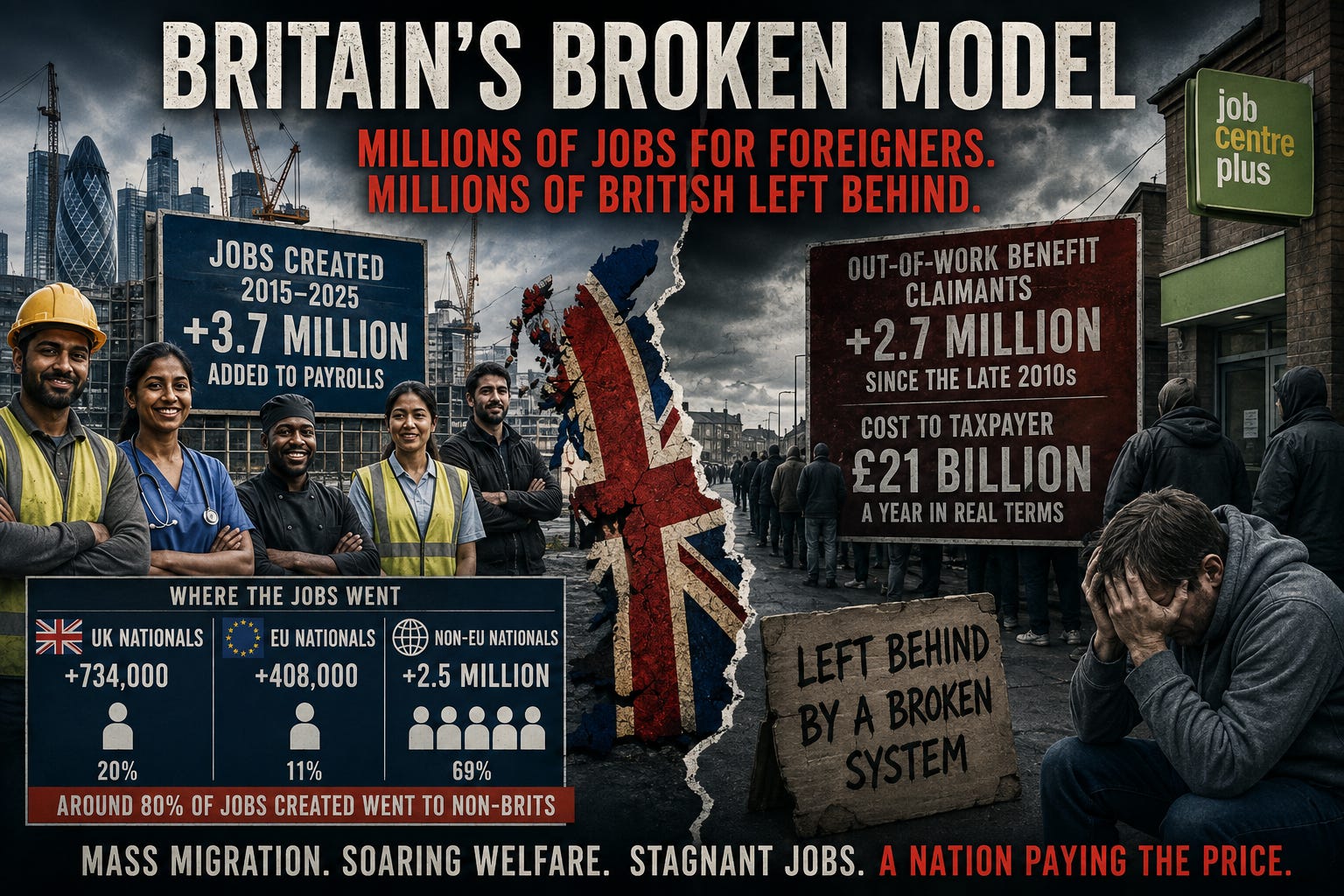
Why Britain ISN’T working!
The David Vance BriefingRead More
The problem with gradual change is that you don’t really get perspective on it as it unfolds, and then, when you DO realise what has happened, it may be too late! I wanted to talk to you about a very profound shift in Britain’s employment market that has taken place since Brexit. It is one that is rarely discussed, but if we can understand it, then maybe we can work out what to do to fix it!
Here’s a shocking fact.
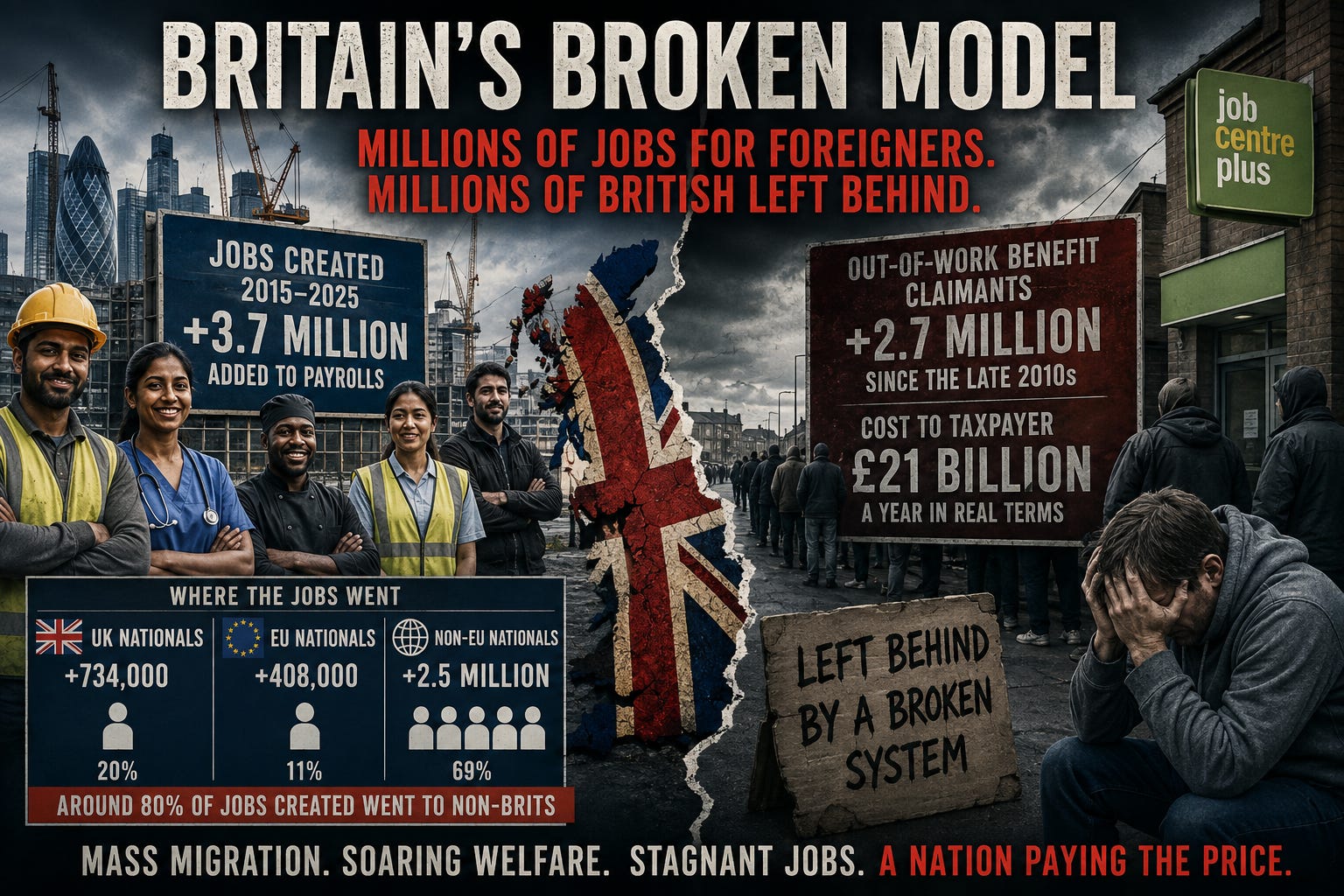
Over the last ten years, roughly 3.7 million people were added to UK payrolls. You might think that is good news until I tell you that only one in five of them were British.
Here is the breakdown:
-
🇬🇧 UK nationals: +734,000
-
🇪🇺 EU nationals: +408,000
-
🌍 Non-EU nationals: +2.5 million
So around 80% of jobs created in TEN YEARS went to non-Brits! Just think about that!
We can see that the primary source of net employment growth in the UK has come from OUTSIDE the EU. This is really quite an astonishing statistic. Non-EU workers have piled into the jobs market to quite a remarkable degree. I don’t recall us voting for that? Take back control didn’t mean handing over the jobs to those living beyond our shores.
In parallel with this, the number of people claiming out-of-work benefits has increased by around 2.7 million. I have previously discussed, in my article about Reform’s welfare plans, how spending on unemployment and incapacity benefits has soared by approximately £21 billion a year in real terms. So millions of non-EU workers are pouring into the UK economy as millions already here claim benefits and leave the productive economy!
You don’t need a degree in economics to work out that something has gone badly wrong.
The longer-term picture
One of our best data sources comes from HMRC payroll data, and when we study it, we can see that UK-national employment has grown only modestly over the decade and, in some recent periods under Labour, has even fallen.
No one is going to be surprised to discover that EU-origin employment soared in the run-up to Brexit and then declined. Non-EU employment, by contrast, has surged — especially in health and social care, hospitality, administration and other sectors.
When you dig deeper into the data surrounding non-EU workers coming here, India and Nigeria are the two main non-EU nationalities driving UK payroll employment growth since 2021. Indian nationals hold the largest number of non-UK payrolled jobs (975,100 in December 2024) and recorded the biggest absolute increases, while Nigerian nationals form the second-largest growth group, particularly in health and social care. Other significant contributors include Pakistan, the Philippines, Bangladesh and Ghana, with the overall rise in non-EU employment far outpacing that of both UK and EU nationals in recent years.
How the hell has this been allowed to happen?
What’s really frightening is that, as millions poured into our nation, the welfare bill expanded exponentially. Out-of-work benefit claimants have risen sharply since the late 2010s. A large share of the increase is linked to health and disability claims, particularly mental health conditions. Real-terms spending on these benefits has climbed accordingly.
The result is a dual economy of sorts: a demand for employees that is increasingly met by non-EU migration, alongside a large and growing group of working-age British people who are economically inactive and dependent on the state.
I can’t think of a more dysfunctional economic model, can you?
The recent slowdown
If what I have laid out is not mad enough, we can now see how this is being compounded by a sharp deterioration in overall job creation. Since Labour took office in mid-2024, the picture has turned consistently weak. Small positive months have become rare; most recent months show flat or negative changes. It is undeniable that the timing of this aligns with Rachel Reeves’s announcement and introduction of the National Insurance hike on employers. The chart below makes the inflection point hard to miss.
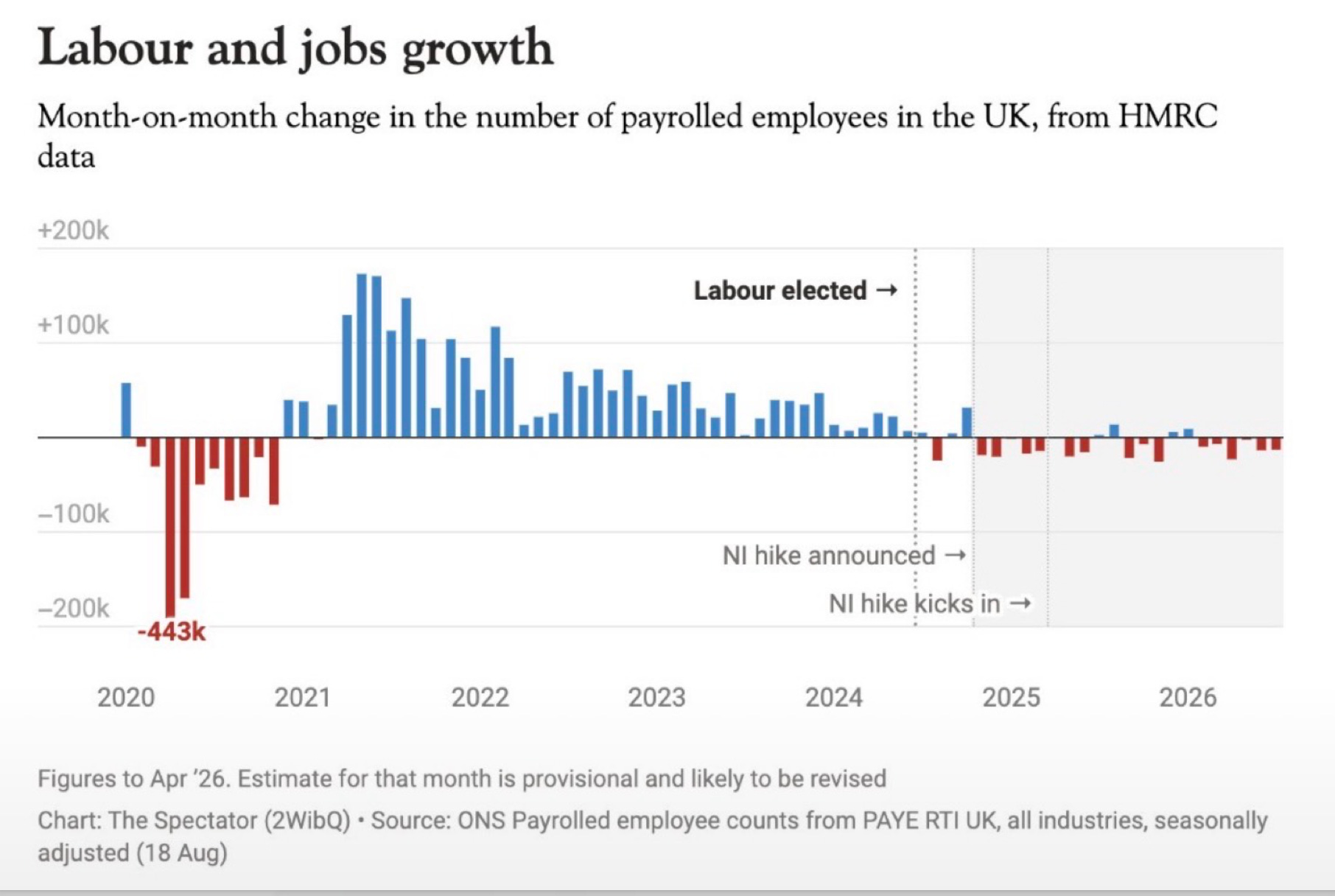
It’s just not possible to dismiss this as some sort of statistical anomaly. Employers are confronted with higher employment costs just as the labour market is already heavily reliant on non-UK workers. Employment static, welfare soaring, and Andy Burnham talks about buses. This combination is toxic for job creation.
Why all of this matters
An economy that relies on high levels of migration to fill immediate vacancies and support sectors facing shortages is one that has deep structural and inevitably social problems. But when this becomes the primary engine of employment growth while domestic inactivity rises, the red flags are everywhere!
Younger and lower-skilled British workers are struggling to gain a foothold in the jobs market. Foreign workers from outside the EU have taken their job prospects, and that is not sustainable.
This, in turn, places even more pressure on the public finances. Higher welfare spending, combined with the infrastructure, housing and public-service demands of rapid population growth, is fiscally ruinous.
The post-2024 slowdown makes this even worse. When payroll growth stalls or even turns negative, the nationality element of any economic growth becomes even more politically charged and economically sensitive. A model that adds millions of non-UK workers while millions of British citizens remain outside the labour market is not resilient. It is a pressure cooker that has to explode.
What is the way forward?
Any competent government would recognise that migration, tax and welfare reform must be treated as interconnected parts of the same problem. I do think this is what Reform is at least trying to think through. Labour seems absolutely unwilling even to consider this, which is why our short-term economic prospects are poor.
Migration policy should be dramatically overhauled. We have to stop the UK becoming a dumping ground for cheap foreign labour.
Welfare reform must reduce the things that keep people on long-term benefits, particularly those related to mental health and milder conditions, while expanding genuine support into work.
Tax policy should make it more attractive for employers to hire and train British workers — especially the young and those returning from inactivity — rather than defaulting to overseas recruitment.
Rachel Reeves’s unbelievably stupid decision in 2024 to raise employer National Insurance while overall job creation was in a slump just made things worse.
There is a brutal reality here.
We have created a British economic model in which most new jobs over the past decade have gone to non-UK nationals. This happened while out-of-work benefit claims rose by more than 2.5 million and spending on key benefits climbed by £21 billion a year.
We CANNOT go on like this.
Fixing this will require political courage, and that is the one commodity that is scarce!
STOP!
Please take a moment to support my work
I publish regular political analysis, overlooked history, book reviews and original commentary that you won’t find in the mainstream media.
Free subscribers receive every article I publish.
Paid subscribers receive everything above, plus The Saturday Briefing — my exclusive weekly analysis launching this September. Each edition will pull together the week’s most important political developments, highlight stories the mainstream media has ignored, and explain what they really mean.
If you value independent journalism and want to help support my work, I’d be delighted to have you on board.